Why is the Egg Industry Delaying on In-Ovo Sexing Technology?
As part of our Ban Hatch & Dispatch campaign, the Vegetarian Society is advocating for the adoption of in-ovo sexing technology across the egg industry. This is a proven technology that has already been adopted at scale globally. Despite this, the egg industry in the UK is prevaricating, arguing instead for the use of day-zero sexing technology. What is the difference, and why do we argue for in-ovo technology?
What is day-zero sexing technology?
Day-zero sexing technology is designed to sex eggs in advance of their incubation. This might work in a few ways. Firstly, day-zero tech might use hyperspectral imaging and statistical modelling to identify male and female chicks in the egg. Alternatively, tech might exist to make it so that male chicks are not laid, thereby removing the need to sex at all through genetically modifying the chickens so that male eggs are not produced. Finally, this might be through genetically modifying the egg-laying hens so that the male chicks are more visible in the egg.
What is in-ovo (in-egg) sexing technology?
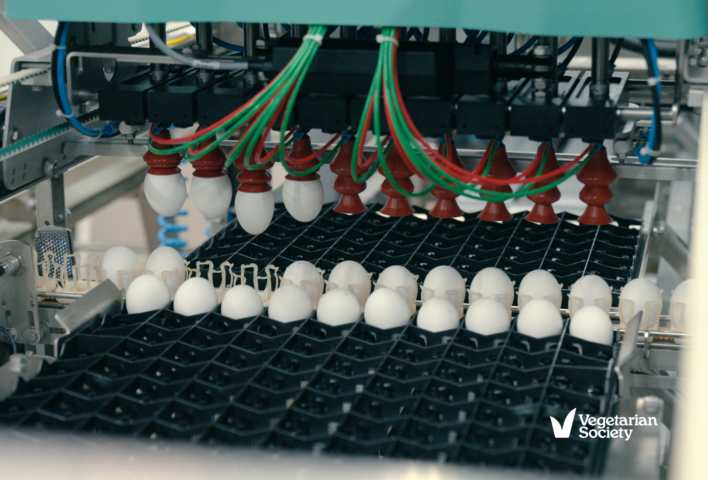
In-ovo technology determines the sex of the chick while it is in the egg. This can be done currently from as early as 9-10 days after laying. Recent advances might also enable this to be done as soon as 4 or 5 days.
When is day-zero likely to be usable?
The availability of this technology is not expected to be any time soon – nor has it been proven to work at scale. Neither of the two main day-zero tech companies has provided an estimated (or even target) date by which they expect to be able to use the technology in the industry at large.
What would the effects of waiting for day-zero be?
Commercially available sexing technology exists today, and is used in multiple countries across Europe. Waiting for a hypothetical technology to become commercially available could lead to a significant impact on male chicks here in the UK. Around 45 million male chicks are killed in the UK every year. Waiting five years would lead to the unnecessary deaths of more than 200 million male chicks. 10 years – a not unbelievable length of time – would cause at least 450 million male chicks to die for no reason.
What does the public want?
Evidence shows that the public are broadly in favour of ending male chick culling, and are happy to pay a small surcharge to pay for the technology to enable this. Over 75% of respondents agreed that they would accept an additional cost of 1p per egg if this enabled saving the lives of the 45 million male chicks who are currently killed every year. Waiting for hypothetical, more advanced tech would surely cost more than this to be usable.
The public is also unlikely to be happy with the genetic modification necessary to make much of the day-zero tech work. 40% of respondents to a YouGov survey (at time of asking) agreed that genetically modified food is ‘potentially dangerous and should not be allowed in food products’.
Why is the egg industry delaying?
The egg industry is arguing that we should wait until the hypothetical day-zero technology exists, and not attempt any change before then. This gives them at least several years of continuing their current practices unabated – and in all likelihood, 5-10 years more. By arguing for hypothetical tech, rather than the currently commercially available technology, the egg industry gives itself a period of grace that it does not deserve.
What should the UK do instead?
The Vegetarian Society believes that stopping the practice of killing millions of male chicks every year is essential. To this end, we are working tirelessly to secure an end to this cruel practice, and an implementation of the currently commercially available in-ovo sexing technology.
This technology is proven to work and has been currently implemented throughout much of Europe already. Finally, it would save 45 million chicks from being born just to be killed shortly after every year, immediately.
You can write to your MP to ask them to back a ban.
You can also sign our petition.
Lettuce Keep You in the Loop

We are a collective of determined people, connected by our shared belief in a better future for every life on earth. Keep up with our work and sign up to our newsletters...
Follow us on social