New research: Why dual-purpose chickens aren’t the answer to male chick culling
New research commissioned by the Vegetarian Society finds that dual-purpose chicken breeds are not a viable solution to ending the routine culling of male chicks; strengthening the case for in-ovo sexing technology.
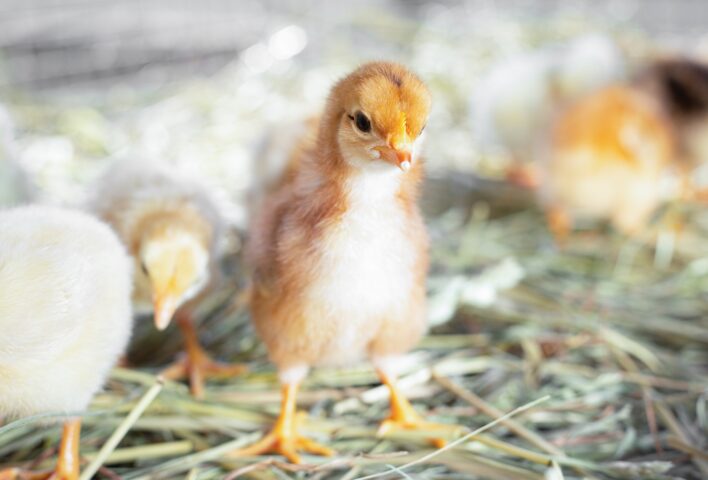
Around 45 million male chicks are killed in the UK every year because they cannot lay eggs and are not considered suitable for commercial meat production. Most are killed within hours of hatching. We are working tirelessly to end this practice through our Ban Hatch & Dispatch campaign.
In answer to a recent parliamentary question, the Government said it is “monitoring the rapid progress currently being made with in-ovo sexing and has funded research into the use of dual breed chickens that remove the need to kill male chicks.”
This interest in dual-purpose chickens – breeds that can be used for both egg and meat production – prompted new research commissioned by the Vegetarian Society. The research concluded that, while dual-purpose breeds may offer some welfare benefits compared with highly specialised commercial breeds, they cannot realistically replace existing egg production systems at scale.
New research examines the alternatives
The new report, The Drawbacks of Dual-Purpose Chicken Breeds as a Solution to Banning the Culling of Male Chicks by Jenny L. Mace (animal welfare researcher and visiting scholar at the University of St Andrews) reviews the available evidence on the welfare, environmental and economic implications of using dual-purpose breeds.
The research finds that widespread adoption would require significantly more chickens to be bred and reared to produce the same amount of eggs and meat.
This could mean:
- More chickens would need to be reared to maintain current levels of egg production.
- More land and resources would be required, increasing the environmental footprint of egg production.
- More animals would be exposed to farming systems, rather than addressing the underlying problem of male chicks being considered commercially unwanted.
- The approach would therefore not provide a practical, sustainable replacement for current egg production systems at the scale required in the UK.
The report does recognise that dual-purpose breeds can offer some welfare improvements over highly specialised breeds. However, its findings show that these benefits do not make them a commercially or environmentally viable solution for ending the routine culling of male chicks.
So, what is the solution?
The research strengthens the case for in-ovo sexing technology.
In-ovo sexing allows the sex of a chicken embryo to be determined before it reaches the stage at which it can experience pain. Male embryos can then be prevented from hatching, meaning male chicks do not enter the egg production system and are not routinely killed after hatching.
Crucially, in-ovo sexing addresses the problem at its source: male chicks do not need to be hatched in the first place.
This means it can enable the egg industry to continue producing eggs without the routine culling of millions of newly hatched male chicks.
Removing the barriers to change
This latest research follows another report commissioned by the Vegetarian Society, ‘Sustainably feeding captive raptors and reptiles: Are there alternatives to culled male chicks?‘ which examined alternatives to using culled male chicks as feed for birds of prey.
Together, these two pieces of research address two arguments that have been raised in discussions about the UK’s transition away from male chick culling:
What happens to male chicks if they are no longer culled?
Research has identified alternative sources of feed for birds of prey.
Could dual-purpose breeds replace conventional egg-laying breeds?
The latest research finds that they are not a viable solution at the scale required.
The evidence therefore points towards in-ovo sexing as the most practical and sustainable route to ending the routine culling of male chicks while maintaining commercial egg production.
The UK Government has already committed to action
There is growing momentum for change.
In December 2025, the UK Government committed in its Animal Welfare Strategy for England to work with industry to deliver a transition to in-ovo sexing technology. This commitment was reaffirmed in the Farming Roadmap 2050, published in 2026.
The technology is also already being adopted internationally. Countries and companies are beginning to move towards in-ovo sexing, demonstrating that alternatives to routine male chick culling are possible.
The question for the UK is now how quickly that transition can be delivered.
Time for a clear roadmap
The Vegetarian Society has been campaigning for an end to the routine culling of male chicks since April 2025 through our Ban Hatch & Dispatch campaign.
The latest research reinforces our call for the Government to turn its commitments into action by setting out a clear timeline and roadmap for the adoption of in-ovo sexing technology in the UK.
Ending the routine culling of male chicks is achievable. The evidence increasingly shows that in-ovo sexing provides a practical way forward.
Read the full report: The Drawbacks of Dual-Purpose Chicken Breeds as a Solution to Banning the Culling of Male Chicks
Want to help end male chick culling? Find out more about our Ban Hatch & Dispatch campaign and add your voice to the call for change.
[JC1]Link to actual report here: https://www.maceanimalwelfare.co.uk/wp-content/uploads/2026/06/Dual-purpose-breeds-statement.pdf. We should consider also uploading this and the raptor feed one on our website so people (ie government) can easily access it
[JC2]Link to report: https://www.maceanimalwelfare.co.uk/wp-content/uploads/2026/04/Alternatives-to-current-raptor-reptile-feed-combined.pdf Again, this could also sit on our website



Lettuce Keep You in the Loop

We are a collective of determined people, connected by our shared belief in a better future for every life on earth. Keep up with our work and sign up to our newsletters...
Follow us on social