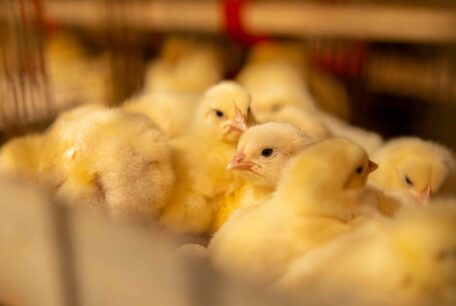
UK egg industry urged to end male chick culling now
Nick Allen, the Chief Executive of the British Egg Industry Council recently wrote into The Scottish Farmer, asserting that the industry was not ready to end Male Chick Culling.
Our Chief Executive Officer, Richard McIlwain writes in response.
Sir,
I’m writing in response to the recent letter from Nick Allen, chief executive of the British Egg Industry Council (BEIC), published on March 12 by The Scottish Farmer.
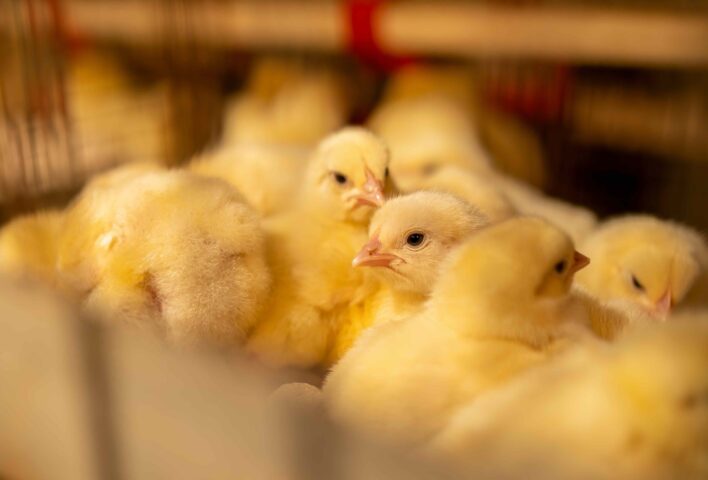
Our campaign seeks to end the culling of male chicks by the egg industry, and to replace the current practice (that of killing 45 million chicks a year within a day of hatching) with in-ovo sexing technology.
This technology determines the sex of the chick while it’s still in the egg. Depending on the method, this can be done as early as day nine or 10 of incubation and critically prior to the development of pain reception in embryos (though researchers in Canada have developed and commercially trialled a method which can cut that to day four or five).
Nick asserts that ‘Day-Zero’ technology is ‘widely regarded within industry as the most ethically consistent long-term solution’ and is the expressed preference of the respondents to BEIC’s own survey.
However, there is one clear issue: ‘Day-Zero’ technology is not yet available. It also requires the use of genetically modified egg-laying hens, altering their DNA such that they only produce female chicks. This is not currently permitted under UK law and Defra has not yet indicated if it intends to legislate to allow gene-editing of animals for food supply on the UK market. Of course, such a step is also likely to face public opposition.
As the first country to implement a ban, Germany’s egg industry did experience teething problems. The ‘Day Seven’ rule has been appropriately revised in accordance with technological limitations, in an example of business and government working closely together to achieve better outcomes.
And with many other countries now using in-ovo technology there is a lot that can be learned from their experiences which will help adoption in the UK.
Nick suggests that the UK market for eggs is substantially bigger than other countries which have implemented in-ovo technology. But major egg-producing countries have already taken action. France and Germany have both moved to require in-ovo technology within their egg industries and the Netherlands has announced a roadmap to a male chick-culling ban, with most eggs produced in the country now, in fact, already produced without male chick-culling.
We invited Nick, alongside several large-scale egg producers, to meet with in-ovo sexing providers to Dutch hatcheries at a Parliamentary roundtable last month. Nick and his guests declined to attend, which was a shame as the round table discussion was an open and constructive session, recognising there were barriers to overcome but very much focused on finding solutions. MPs attending were clear that they want to see a deadline and roadmap for transition to in-ovo sexing here in the UK.
On the subject of barriers, Nick suggests that we have not considered the secondary market for supply of dead chicks as feed for reptiles and birds of prey. We have, in fact, published research into this very issue and hope to meet Defra soon to encourage ministers and officials to build on this research. After all, even if it’s the case that ‘Day-Zero’ technology is adopted at some point in the future, an alternative to the use of dead chicks for animal feed will need to be found.
The UK is in danger of being left behind in terms of animal protection, with numerous European countries having already adopted the technology or with clear deadlines for adoption. And technology providers have indicated that equipment can be upgraded as further developments improve the accuracy and date of sex detection further.
Waiting for technology which is not yet commercially available and will require gene-editing legislation to be in place isn’t a satisfactory option if we want the UK’s proud reputation for quality food and animal protection to remain unquestioned.
Repeated polling has shown that an overwhelming majority of Brits support a ban and that over three-quarters would happily pay more for more ethically-produced eggs. In the spirit of openness, we have made available to The Scottish Farmer the reports underpinning our research – I trust BEIC will follow suit.
As ever, we remain open to constructive dialogue with BEIC and the UK egg supply chain and remain hopeful that they will follow the example of their counterparts in Europe – and together we can develop a roadmap which responds to the public’s concern, protects farmers’ incomes, and considers the needs of smaller hatcheries.
And critically, prevents the needless deaths of some 45 million male chicks every year.
Richard McIlwain, CEO of The Vegetarian Society


Lettuce Keep You in the Loop

We are a collective of determined people, connected by our shared belief in a better future for every life on earth. Keep up with our work and sign up to our newsletters...
Follow us on social