How to Skip the Chore of Reading Food Labels
How do you make sure that the products you’re buying are actually suitable for your lifestyle and dietary choices? Many products appear vegetarian or vegan at first glance, but ingredients, processing methods and unclear labelling can make things more complicated. You want to be certain that the things you buy meet your personal standards – but poor-quality labels and packaging can make this more difficult than it needs to be.
With our easy guide, you won’t have to go through the process of studying the label anymore.
Why having to read labels can be a chore
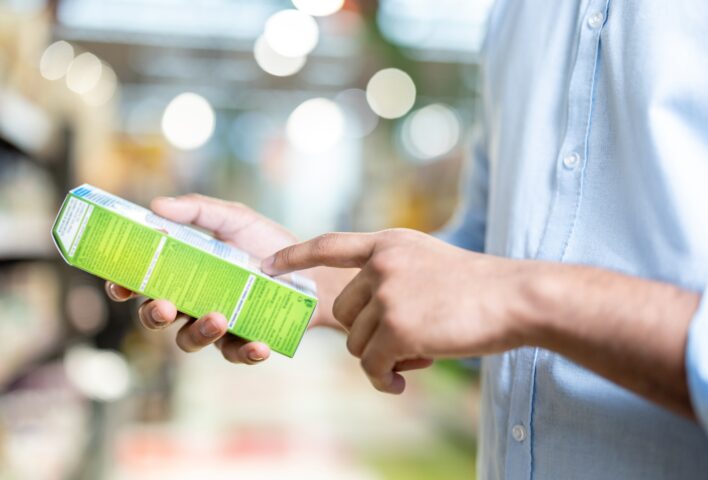
If you’re a vegetarian or vegan, you’ve probably had to spend some time in the supermarket, online or in a shop studying the label on something you’d thought about buying. It should be simple to figure out if something fits your lifestyle or dietary requirements, but it isn’t always.
- Some animal-derived ingredients are hidden behind unfamiliar names. You don’t want to accidentally eat or use a product you wouldn’t want by not understanding the ingredient’s name.
- Ingredients or materials can change over time. For example, sometimes manufacturers add or substitute ingredients without letting the consumer know, or a manufacturer might start using a material that is animal-derived.
- Things you wouldn’t expect to contain hidden animal products sometimes do. Products that are commonly thought of as vegetarian or vegan sometimes aren’t.
- Legislation doesn’t always require all ingredients to be mentioned – fining agents in alcohol for example don’t need to be disclosed on a label.
- Some manufacturers don’t always have a clear understanding of what is vegetarian or vegan and what isn’t.
- Reading the label itself can be difficult – they are often small and poorly optimised for the 75% of people worldwide who need some form of vision correction.
Common animal-derived ingredients:
- Gelatine – Gelatine is sometimes used in skin care products. It is extracted from bones and offal through boiling.
- Animal rennet – made from the lining of the stomachs of ruminant animals.
- Cochineal (carmine/E120) – Carmine (and cochineal) are bright red dyes, formed from crushing insects.
- Isinglass – Isinglass is a type of collagen, made from drying out the swim bladders of various fish. Isinglass was traditionally made from sturgeons, although now it is made from a range of tropical fish.
- Shellac – Shellac is made from the resinous secretion of insects. It takes a vast number of insects to produce shellac – perhaps 300,000 to make just one kilogram.
- Caprylic Acid – Used in a massive variety of products, Caprylic Acid comes from compounds that form in the milk of mammals – cows, sheep and the like. It has antifungal and antibacterial qualities and is therefore used in sanitizers and disinfectants.
- Guanine – Guanine is a pearlescent substance, used decoratively in a variety of make-up, shampoo and nail polish products. This is made from ground up fish scales. It can also be referred to as pearl essence, extract or powder. Alternatives can be made from metals, like aluminium or bronze – as well as plants.
Ingredients that require extra consideration
- Lecithin (usually plant-derived but not always) – Lecithin is a natural fatty substance made of phospholipids, fatty acids, and choline, found in animal and plant tissues. Plant-derived sources can include
- Mono- and diglycerides (may vary) – Mono- and diglycerides are common food additives primarily used as emulsifiers to blend water- and oil-based ingredients that would otherwise separate. They stabilize the texture and extend the shelf life of everyday packaged foods like baked goods, ice cream, margarine, and peanut butter. They can be manufactured from plant oils or animal fats like lard or beef tallow.
- Xanthan gum – Xanthan gum is a popular food additive used primarily as a thickening agent, stabilizer, and binding agent. It is created when plant-based sugars and bacteria are fermented. However, it is possible to also cultivate on other surfaces including milk-derived sugars (lactose).
- Beehive based ingredients – Some food and cosmetic manufacturers might include things that come from the beehive (not just honey) in their products, wrongly thinking that they are vegan. This might include beeswax or royal jelly.
Understanding food certification marks
What are the Vegetarian Society Approved Certification Marks?
The Vegetarian Society Approved Certification Marks are on thousands of products in shops all over the UK, EU, USA and many other countries. They certify that the products they appear on are vegetarian, vegan or plant-based.
How certification simplifies shopping
When you see a Vegetarian Society Certification Mark, you know that the product you see it on is suitable for your dietary or lifestyle requirements. This means you don’t have to check out the ingredients list as you can be confident that the Vegetarian Society has already made stringent checks. You can spot the Certification Marks easily on products to save time and hassle, making your shopping quick and easy.
What’s the difference between our Certification Marks?
At the heart of all three marks:
- No ingredients derived from animal bodies
- No animal testing carried out or commissioned
- Strict controls to prevent cross-contamination during production
- No genetically modified ingredients
From there, each mark builds a little further:
Vegetarian Certification – products must avoid all ingredients resulting from slaughter and only use free-range eggs where applicable.
Vegan Certification – products go further still, excluding all animal-derived substances entirely – including dairy, eggs, and honey.
Plant-Based Certification – our highest level of certification. Products must meet all of our vegan standards, while also ensuring plants are the defining ingredients – making it easy to identify products that are truly plant-based.
Why third-party certification provides greater confidence than front-of-pack marketing
Vegetarian Society certifications are internationally recognised. All products featuring the certification marks go through a rigorous checking procedure, to ensure that the product meets the standard of the required certification.
Unexpected examples of unsuitable foods:
Why you should always look for our certification marks
- Don’t always trust the suitability statement. Some products don’t contain a mark but do say ‘suitable for vegetarians / vegans’ or something similar. This isn’t always as reliable as a certification mark which is backed by rigorous checks.
- It can be difficult to read the ingredients list in a shop, especially if you can’t see the label clearly. If you aren’t certain, you can read through the ingredients to see if there’s anything animal derived hidden inside the product. However, this can still be problematic, as it does not account for the production process.
Make shopping easier with certification marks
Learning a handful of key ingredients can make shopping much easier. Knowing what common animal ingredients go by seemingly innocuous names can make it much easier to avoid them. However, this is not a simple or fool-proof process.
Vegetarian Society Certification Marks are the quickest way to shop with confidence and easily verify that a product is Vegetarian, Vegan or Plant-Based.
Learn more about our certification scheme process below.
Lettuce Keep You in the Loop

We are a collective of determined people, connected by our shared belief in a better future for every life on earth. Keep up with our work and sign up to our newsletters...
Follow us on social