
How quickly is adoption of In-Ovo technology growing Worldwide?
What are the recent developments, and where is the UK at risk of falling behind?
Every year, more than 40 million male chicks are killed in the UK on their first day of life. This is because they aren’t deemed as profitable to the egg industry as they can’t lay eggs in the future. The Vegetarian Society has been campaigning against this for more than a year. Ban Hatch & Dispatch raised critical awareness of this cruel and unnecessary practice to the extent that the Government is now including its desire to end male chick culling in official strategy documents. Now, it’s time to turn promises into actions.
In-Ovo technology allows eggs to be sexed at a very early stage, preventing the male chicks from being born only to be killed.
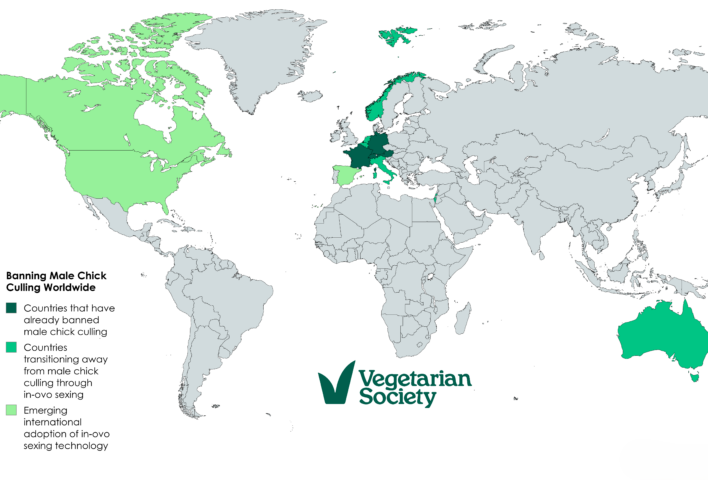
In-ovo sexing technology is a clear path forward to ending male chick culling, as demonstrated by its increased adoption across countries worldwide.
So, where is In-Ovo technology currently used, and how can the UK speed up its adoption? According to a new report from Innovative Animal AG:
Europe
- Around 40% of the commercial egg laying hens in the EU had their eggs sexed with in-ovo technology. This represents a growth of six percentage points from April 1, 2025.
- In Europe, In-Ovo sexing technology has reached a production rate of 100 million female chicks per year, climbing from 500k chicks per month in 2021 to well over 8 million female chicks today.
- In Switzerland, where in-ovo sexing technology started in 2025, in-ovo sexing usage has grown rapidly and now represents between 85 and 100% of the country’s layer flock.
- In Norway, in-ovo sexing has reached more than 50% market penetration. Hatcheries, egg producers, retailers and an animal-welfare organization joined a roundtable managed by the country’s poultry association. The group established a common implementation timetable and ran a formal procurement process.
- Sweden, Denmark and Finland are showing signs of following Norway’s lead.
- Italy’s ban on male-chick culling is due to take effect in January.
- The Netherlands already has hatcheries equipped with in-ovo sexing technology
Worldwide
- Since 2021, over 281 million male embryos have been removed before hatching globally.
- In-ovo sexing is beginning its rollout in the US with over 4% of the country’s commercial layer flock having publicly announced a transition to use the technology.
- The global growth of In-Ovo sexing is forecasted to continue in the next few years, led by expansion in the US, strength in Europe, growth in markets where the technology has recently entered such as Australia and Brazil, and potential penetration into new markets like Canada and China.
Where is the UK Now?
The UK is currently falling behind the rest of the world. Egg industries, governments and retailers have worked together already in our near neighbours to agree on a timetable and a plan to end the practice of male chick culling. This resulted in hundreds of millions of male chicks being saved from a short life and rapid death. The UK industry is prevaricating in the face of popular support for an end to the practice, and a government that is increasingly supportive of ending it.
Experts believe that In-Ovo Sexing is the clearest way forward to bring about an efficient and ethical alternative to male chick culling – as it is already used successfully across much of the world.
How can I help?
Show your support by signing the petition today.
You can write to your MP with our handy tool.
Talk to your friends and family to help raise awareness and bring an end to male chick culling in the UK.



Lettuce Keep You in the Loop

We are a collective of determined people, connected by our shared belief in a better future for every life on earth. Keep up with our work and sign up to our newsletters...
Follow us on social