
Are Dual-Purpose Chicken Breeds a Solution to Male Chick Culling?
New research shows dual purpose chicken breeds are not a suitable alternative to male chick culling. Every year, 45 million male chicks are culled in the UK, because they cannot lay eggs. These male chicks cannot be raised for meat, because the egg industry uses specialised chicken breeds that are unsuitable for meat production.
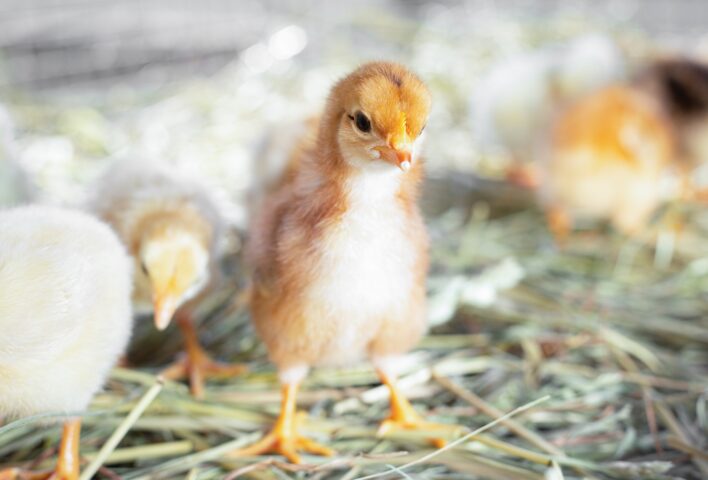
This is a major animal welfare issue, as it leads to the early death of millions of male chicks, for no reason other than their sex. The Vegetarian Society is campaigning to ban this practice, but the egg industry is proposing alternatives. We explore whether these are actual solutions, and what we recommend instead.
Solutions to male chick culling
In-ovo sexing technology has been shown time and time again to be the most effective, efficient and ethical alternative to male chick culling. This is an advanced technology that enables egg producers to identify which eggs are male and which are female at an early stage. This means that rather than allowing the chicks to hatch and then be gassed or otherwise killed, the eggs containing male chicks can be disposed of pre-sentience. This allows earlier, less harmful intervention and is a feasible, practical solution that can be used today.
The possibility of dual-purpose chicken breeds has also been discussed as a potential solution to male chick culling. These are chickens that have been bred to be usable both for egg and meat production. In this scenario, the male chicks would be used for meat, while the female chicks would be used for egg production. New research by Jenny L. Mace, BSc, MSc AWSEL, FHEA
What does the research say about dual-purpose chicken breeds?
This new research shows that there are significant welfare concerns involved in dual-purpose chickens. Fundamentally, modern purpose-specific breeds are more specialised than dual-purpose breeds. This means that more chickens would be needed overall to produce the same amounts of meat and eggs. Without changes to infrastructure, more chickens will be exposed to intensive farming conditions, transport stress and cruel slaughter processes. Male birds from dual-purpose breeds will take longer to develop to a size the industry wants for meat, thereby prolonging their suffering.
The environmental cost of dual-purpose breeds
More chickens (which would be needed to match single-use breed efficiencies), would lead to higher resource use. This would include more land needed for both housing and feed, with the associated increased environmental footprint. Increased farming pressures also damage wildlife through increased habitat loss. This means that the benefits of dual-purpose breeds are limited to small scale farming, rather than the industrial production that makes the majority of British eggs and chicken meat.
Economic and social issues
It is also likely that dual-purpose breeds would lead to higher costs than current systems. They would lead to more expensive eggs than in-ovo alternatives, as well as much higher meat production costs. The research suggests that industry should also consider uncertain public acceptance of: different meat quality, and smaller eggs. This would lead to a likely outcome of dual purpose breeds being niche, for a premium market only, without large-scale adoption.
Why should the industry adopt in-ovo sexing?
In-ovo sexing technology represents the best immediate solution to end male chick culling. It is already used all over the world, including across much of the UK’s nearest neighbours. Around 40% of the commercial egg laying hens in the EU had their eggs sexed with in-ovo technology. The UK is falling behind on animal welfare, especially when there is such public demand for an end to male chick culling.


Lettuce Keep You in the Loop

We are a collective of determined people, connected by our shared belief in a better future for every life on earth. Keep up with our work and sign up to our newsletters...
Follow us on social